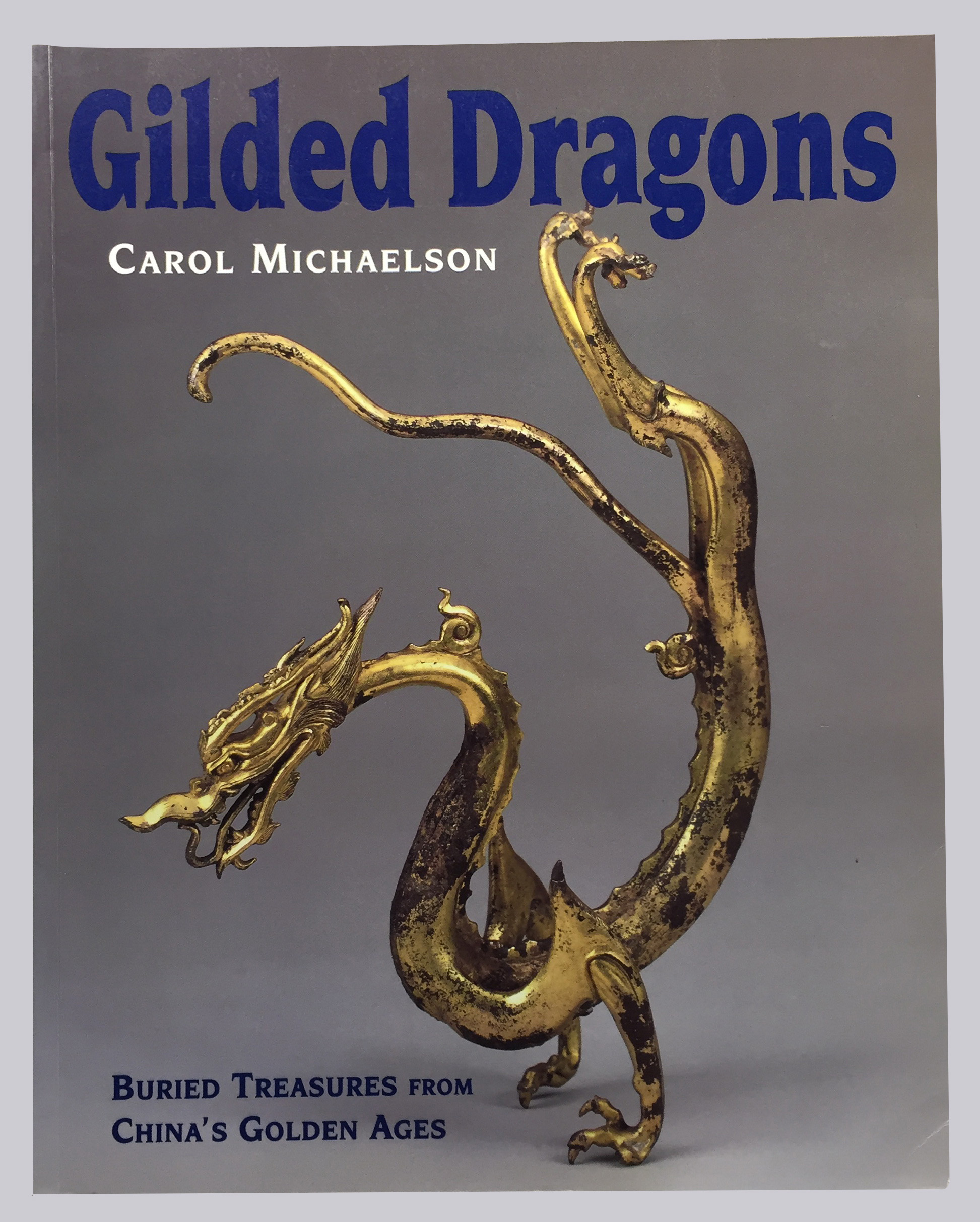
Gilded Dragons: Buried Treasures from China’s Golden Ages
INCLUDES LOOSE FLYER FROM THE EXHIBITION HELD AT THE BRITISH MUSEUM IN 2000.
Some of the most striking and evocative artistic and archaeological objects ever found in China date from the Tang dynasty, which spanned three centuries from AD 618 to 906. Regarded by the Chinese as one of their most glorious golden ages, when their empire was the richest and most powerful political unit in the world, it was characterized by cultural brilliance, territorial expansion and great prosperity. The Tang capital at Chang'an (present-day Xi'an), marking the eastern end of the Silk Routes, was a wealthy cosmopolitan city, benefiting from the flourishing trade in exotic foods, textiles, furs and fine horses via the oasis towns of the Taklamakan Desert. Persians and Turks, Jews and Muslims all lived and worked in the city of 'Enduring Peace', and the eclectic motifs and technical virtuosity of Tang craftsmen can be seen in the splendid gold and silver vessels and jewellery found buried in local tombs, hoards and crypts. Buddhism was an especially pervasive foreign influence, and many precious ritual objects, donated by generations of the imperial family, were recently discovered in an underground palace below the famous Famensi Buddhist temple. This book presents a fascinating panorama of Chinese life during two 'golden ages': the Tang dynasty and its predecessor the Han, which ruled from the third century BC to the third century AD. Over 120 once-buried treasures - some never before seen outside China - are here illustrated in full colour.
Published by British Museum Press, London, United Kingdom, 1999 | Paperback
- Language: English
- Paperback
- ISBN 9780714114897
- 22.5 x 28 cm
- Book Condition: Used, signs of wear.The interior is in good condition.
- 25,00 € (+ shipping)
| Estimate shipping price | Air mail | Standard |
|---|---|---|
| Portugal | — | 7,00 € |
| UK | ||
| Europe | 19,00 € | |
| Rest of the World | 40,00 € |